
HOA online payment systems: features to look for before you choose one

Every month the treasurer opens the mailbox and counts checks. Some owners forget, some mail theirs late, and a few ask whether they can just pay by card. The board wonders whether it is time to move to an online system, and nobody on the board has chosen one before.
HOA online payment systems let owners pay assessments through a website or app instead of by check. This guide explains how they work, which features matter most, and which questions to ask before the board commits.
What HOA Online Payment Systems Are
An HOA online payment system is a service that lets owners pay their assessments electronically, usually by bank transfer or by card. The owner enters payment details, the service moves the money to the association’s bank account, and the board gets a record of who paid and when.
Behind the scenes there are several parts. A payment processor moves the money. A portal shows each owner their balance and history. A reporting screen shows the board what has been collected. Some systems bundle all of these, and some connect to accounting software you already use.
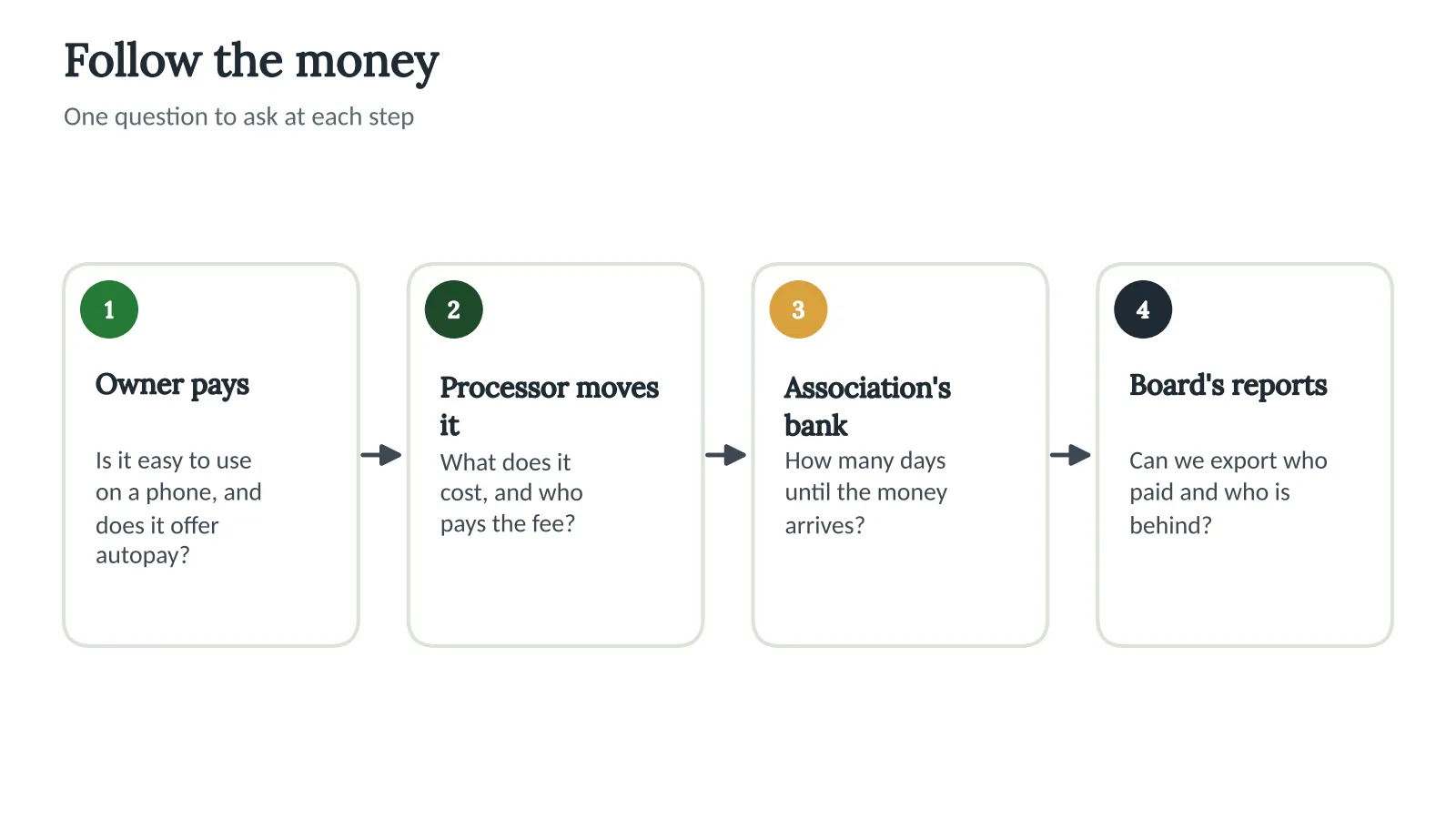
The picture below follows the money from the owner to the association and shows a question to ask at each step.
Why It Matters for HOAs
Collecting assessments is the association’s main source of income, so the method affects everything else. A system that is easy for owners to use can reduce late payments and the time the treasurer spends chasing them. A system that is confusing or costly can do the opposite.
The costs deserve a close look. Here is a made-up example. A 60-home community charges $175 a month. Suppose a system charges 3% on card payments. That is $5.25 per payment, or $315 a month if all 60 owners pay by card, which comes to $3,780 a year. Bank transfers can carry a different fee, and the exact rates depend on the provider. The question for the board is who pays that fee, the association or the owner, and whether your documents and state law allow passing it along.
Other risks include security, how fast the money arrives, and what happens when a payment fails. The board is responsible for the money, so these are not details to leave to a vendor’s brochure.
How HOA Boards Should Handle It
Start by writing down what your community needs, then compare each system against that list. Six features matter most.
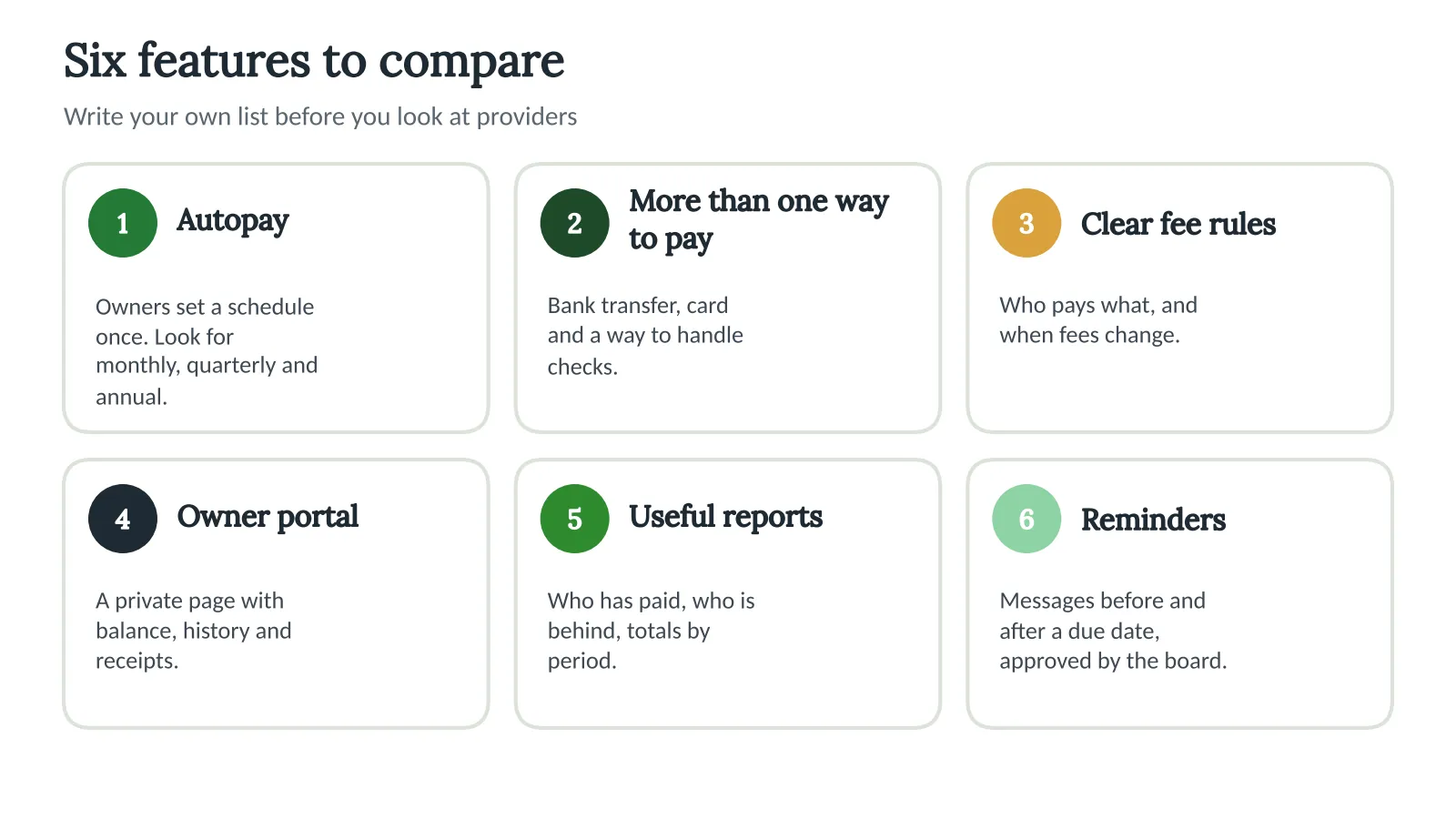
- Autopay and recurring payments: owners set a schedule once, and payments arrive without a reminder. Look for monthly, quarterly and annual options.
- More than one way to pay: bank transfer, card and a way to handle checks during the change.
- Clear fee rules: who pays what, when fees change and whether there is a contract term.
- An owner portal: a private page where each owner sees their balance, history and receipts, ideally linked from your HOA website.
- Reports the board can use: who has paid, who is behind, and totals by period, in a form your treasurer or accountant can export. Our guide to creating a treasurer report shows how to use them.
- Reminders: messages before and after a due date, with wording the board can approve.
Questions to ask every provider
Ask before you sign
- What does it cost per payment, per month and to cancel?
- Who pays the processing fee, and can it be set either way?
- Where does the money go, and how many days until it reaches our account?
- What happens when a payment fails or is reversed?
- How is card and bank information protected, and who is responsible if there is a breach?
- Can we export our data in a standard format if we leave?
- Does it work with our accountant or accounting software?
Ask the provider for its security practices in writing. A common standard for card data is the Payment Card Industry Data Security Standard, so ask whether the service meets it. Have your attorney or accountant review the contract, and compare it item by item with our guidance on smarter contract management.
Plan for late payments
An online system does not replace a collections policy. Write down the steps your documents allow, in order, and follow them for every owner. Our post on collecting assessments and handling delinquencies walks through a typical process, and our guide to paying HOA fees online explains the owner’s side. Check your documents and state law before adding a late fee or a payment plan.
How Technology Can Help
Payments are one part of running the money side, and the records around them matter just as much. Neighborhood.online is not a payment system, and it does not collect assessments or track balances. What it does is keep the surrounding paperwork in one place. Every document, such as the contract with your payment provider, the board’s vote to choose it and the policy for late payments, is stored in one place and searchable inside.
When the board needs to tell owners that the way to pay is changing, a notice can be written once and sent by email, first-class mail or certified mail, the way each neighbor asked. A delivery record shows who got it and when, and nothing goes out until the board approves it. Rules in one place, in plain language, help owners find the late-payment policy without calling the treasurer.
If you want to review next year’s numbers, Neighborhood.online supports reviewing and proposing budgets with a clean audit trail, so the effect of fees and late payments can be discussed before the board votes.
Key takeaways
- Online payment systems move money from owners to the association and give the board records of who paid.
- Compare autopay, payment options, fee rules, an owner portal, reports and reminders.
- Work out the yearly cost, and decide who pays the processing fee.
- Ask about security, speed, failed payments and how to export your data.
- Keep the contract, the board’s decision and the late-payment policy with your other documents.
Frequently asked questions
What features should HOA online payment systems have?
At minimum: autopay, more than one way to pay, clear fee rules, an owner portal, reports the board can export and reminders. Add security and cancellation terms to your list.
Who pays the fees for online HOA payments?
It depends on the provider, your documents and state law. Some associations absorb the fee and some pass it to the owner who chooses to pay by card. Ask your attorney before passing fees along.
Is it safe to pay HOA assessments online?
It can be, when the provider protects card and bank information and the board has checked its security practices in writing. Ask providers how they protect data and who is responsible if something goes wrong.
Can an HOA require owners to pay online?
Your governing documents and state law decide. An association may offer online payment as an option and keep a way to pay by check. Ask an attorney before making it mandatory.


