
HOA vs. homeowner repairs: who fixes what and how to settle the gray areas

A pipe bursts, a fence leans, or an air conditioner stops working, and the owner calls the board to ask who is supposed to fix it. Nobody at the table is sure, so the answer depends on who they ask first.
HOA vs. homeowner repairs is a common source of friction in a community. The good news is that the answer is almost always written down somewhere. This guide shows where to look, why some items cause arguments, and how a board can settle each question the same way every time.
HOA vs. Homeowner Repairs: How the Split Works
Every association divides the work between the association and the owners. The dividing line is set by your governing documents, the rulebook that explains how the community is supposed to run. The declaration (often called the CC&Rs) and the bylaws usually say what the association maintains and what each owner maintains.
Two patterns are common, and the line sits in a different place in each:
- Single-family HOA: the association usually looks after the shared spaces, such as entry signs, roads it owns, a pool, a clubhouse and common landscaping. Each owner usually looks after the house and lot.
- Condo or townhome association: the association usually looks after the building’s outside and structure, such as the roof and exterior walls, plus shared systems. Each owner usually looks after the inside of the unit.
The picture below shows how that often plays out, and it is only a pattern. Your own documents decide, and some communities share an item or assign it differently.
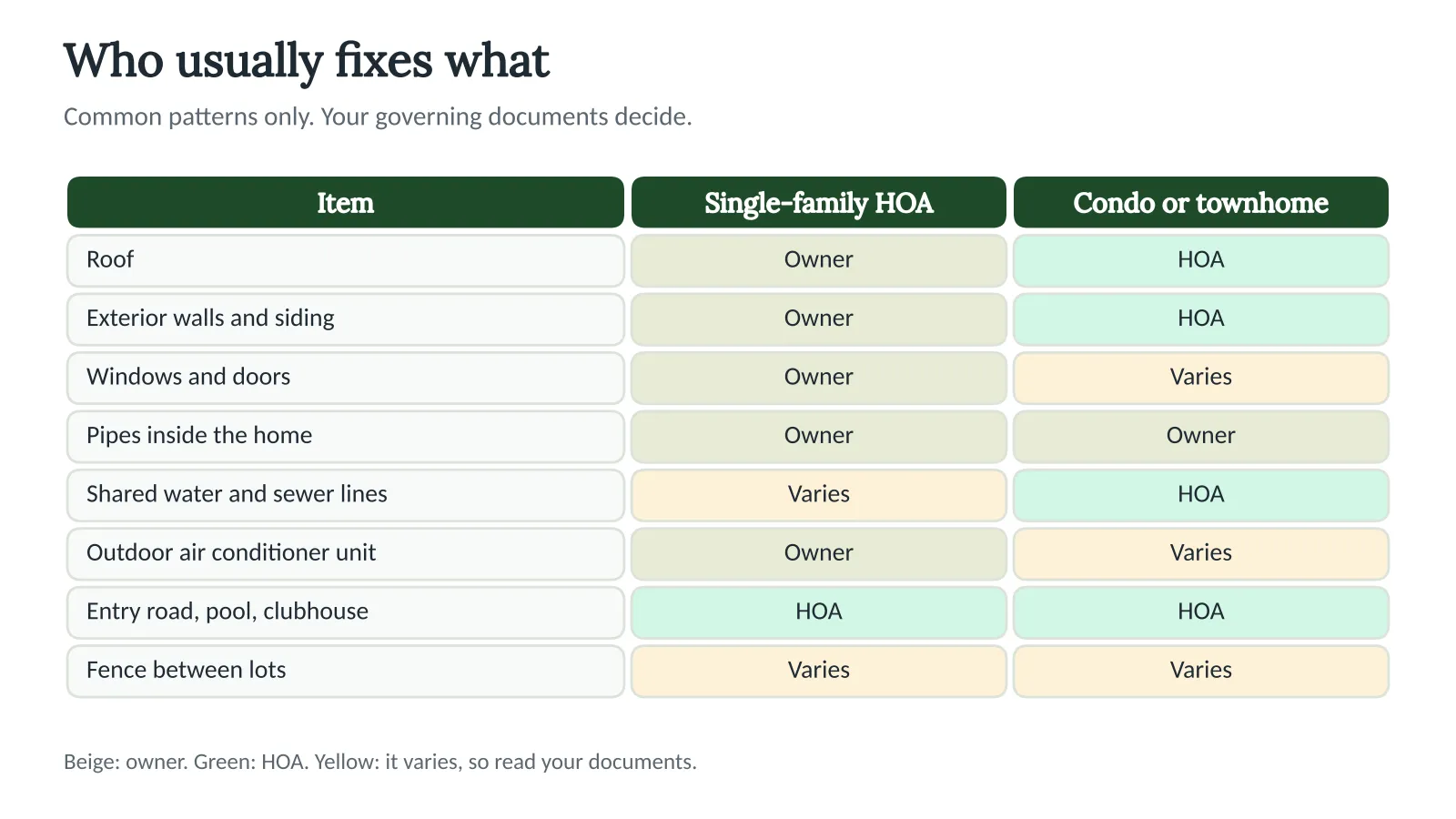
Here is a simple example. A 60-home community owns its entry road and pool. The declaration says owners maintain everything on their own lot. A crack in the entry road is the association’s job, and a cracked driveway on a lot is the owner’s job. If the owner’s driveway runs into the road, the documents should say who handles the apron. When they do not, you have a gray area.
Why It Matters for HOAs
Repair disputes rarely start with the repair. They start with a surprise bill, a long wait or a feeling that a neighbor got different treatment. A few items cause frequent trouble:
- Heating and cooling equipment: the unit inside may be the owner’s while the outdoor condenser sits on common ground.
- Shared pipes: a line that serves several homes may be the association’s until it enters one home, and the documents may name the exact point.
- Windows, doors and balconies: these touch both the building’s outside and the owner’s inside.
- Water that moves between units: a leak in one unit can damage another, and who pays depends on the documents and the insurance.
- Fences and drainage: a shared fence or a swale between lots can belong to nobody on paper.
Insurance adds one more layer. The association usually carries a master policy, and each owner usually carries a policy of their own. Master policies cover different amounts of the building inside the unit, so an owner may think the association covers something when it does not. Owners are better served when the board tells them early to read the master policy and ask their own agent what it leaves out. Our overview of property insurance for HOAs explains the basics.
Finally, treating two owners differently for the same problem invites complaints about unfair enforcement. Our post on selective enforcement explains why consistency protects the board.
How HOA Boards Should Handle It
The goal is to decide once, in writing, and then follow the same steps for every request.
Settle a repair question
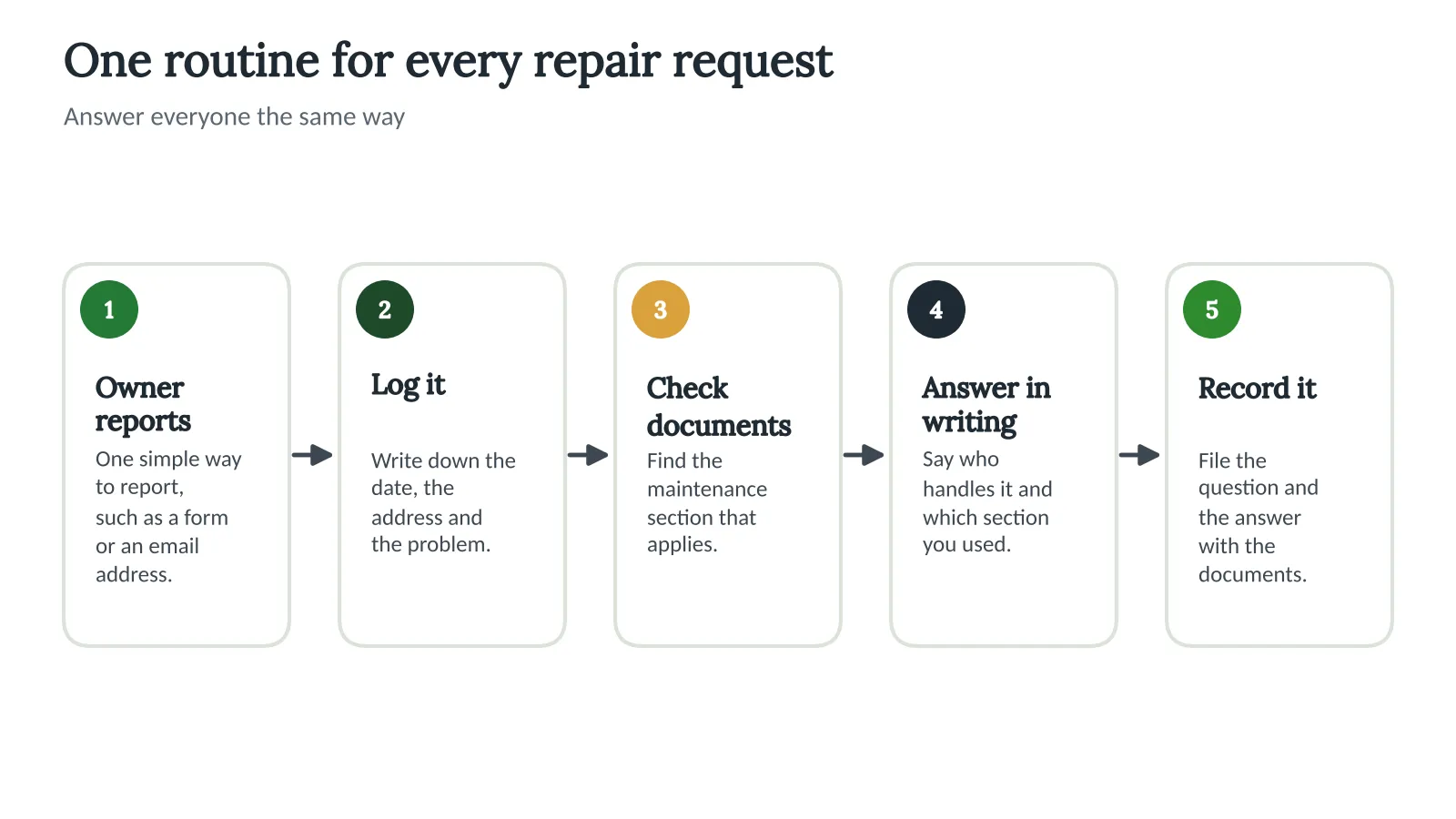
- Read the documents. Find the maintenance section of the declaration and the bylaws. Note the exact words for the item in question.
- Sort it. Decide whether the item is clearly the association’s, clearly the owner’s, or unclear.
- Answer in writing. Tell the owner what you found and which section you relied on.
- Record the decision. Keep the question, the answer and the section number together so the next board finds it.
- Check the insurance. If damage is involved, ask the owner to notify their insurer and have the board contact the master policy’s agent.
For the unclear items, take them to a board meeting and decide the answer for the whole community. Then write a short rule or a policy note so nobody has to ask again. If the documents are silent or contradict each other, ask an attorney before you decide. Changing a rule usually has its own steps, and our post on amending and adding rules walks through them.
Build a responsibility chart
Take the maintenance sections of your documents and turn them into a one-page chart. List each item, who handles it, and the section it comes from. Include the items in the list above even if nobody has asked about them yet. Share the chart with every new owner and post it where owners can find it all year.
Use a repair request routine
Give owners one simple way to report a problem, and answer within a set number of days. The picture below shows a routine you can adopt.
The resident communication templates in the resource center can help you word updates about repairs and maintenance.
How Technology Can Help
Repair questions come back year after year, mostly because the answer was never easy to find. Keeping the governing documents, your responsibility chart and past board decisions in one searchable place means the next board can look up what was decided instead of guessing. Tools like Neighborhood.online keep every document in one place, searchable inside, so the whole history is there when a new volunteer joins.
Vendors matter too. When the association is responsible for a repair, a single list of vendors with contract dates, insurance and W-9 status shows who is ready to do the work, and Neighborhood.online warns before insurance lapses or a contract runs out. Notices to owners about planned repairs can be written once and sent the way each neighbor asked, with a record of who received them.
Key takeaways
- Your governing documents decide who fixes what, so read them before you answer an owner.
- Build a one-page responsibility chart and share it with every new owner.
- Settle gray areas once, in writing, and apply the answer to everyone.
- Remind owners to read the master insurance policy and ask their own agent what it leaves out.
- Ask an attorney when the documents are silent or disagree with each other.
Frequently asked questions
Who is responsible for repairs in an HOA?
It depends on your governing documents. In a single-family community the association usually handles shared spaces and owners handle their homes and lots. In a condo or townhome community the association usually handles the building’s outside and structure, and owners handle the inside of the unit. Read the maintenance section of your declaration to be sure.
Who pays when a leak in one unit damages another?
The answer depends on where the leak started, what the documents say and what each insurance policy covers. Tell both owners to notify their insurers, collect the facts, and ask your attorney or insurance agent before the board decides.
What if our documents do not mention an item?
Decide the answer at a board meeting, record it, and apply it to everyone. If the item is costly or likely to be disputed, ask an attorney first. Then consider adding a short written rule so it does not come up again.
Can the board change who is responsible for a repair?
Sometimes. Changes to maintenance duties may need an amendment to the documents and a vote of the owners. Check what your documents and state law require before the board announces a change.


